Posts in Category: Lifestyle Tips


Smart Driver: Four Simple Ways to Winter-Proof Your Vehicle
There is no doubt that a car takes a pretty big hit during the winter. Not only is there the danger of rust, but you also have to worry about your gas mileage dropping for a while, which means more gas. Do not worry about this; there are a few things you can do to winter-proof your vehicle to get prepared.
1. Have the Tools
One suggestion is to make sure that you have all the tools you might need during the winter in your car. You want to have a shovel, window ice wiper, and a few blankets. You might even want to have a flair gun just in case you get stuck somewhere and need to signal for help. Hopefully, there will be no need to use any of these items, but it is best to be safe.
2. Change the Tires
Depending where you are, the winter can bring additional issues that affect the road. This means your car needs to be ready to deal with slippery roads, and the best way you can do that is by having the right tires. Winter tires, or at least, all seasonal tires will work for those who have to deal with icy roads. These tires will increase your car’s grip. You want to make sure that you have enough grip to avoid slips or even accidents. In essence, you are investing in your safety, and you cannot put a price on that.
3. Protecting the Interior
There is a lot you can do to protect the vehicle’s interior. For one, you can have your mechanic do an inspection of the areas most affected during the winter, such as your electrical system just to make sure everything is optimized. You can also do things like purchasing Weathertech floor mats. Not only will you protect the interior carpets from snow or mud, but you are also going to protect your car against mold growth.
4. Rust Shield
Road salt is your enemy, and you want to do what you can to keep your car from getting rusted after water and salt sticks to your car. It might be a good idea to apply rust-preventative coatings on your car before the winter hits. Not only will this coating help keep the car safe, but it will also make it look nice. You also want to clean your car after snowstorms hit your area, and make sure that you use rust-prevention spray on the undercarriage of the car every few days.
Of course, these are just some of the things that you can do before the winter hits, but there are many other steps to take. For example, you have to make sure that your heater is functioning well because you do not want to face those cold temperatures without a good heater. You might also want to change your battery or at least check to see if it has a good charge. Talk to your mechanic about additional steps you can take to keep your car safe this winter.

The Great British Make (Off)
OK, we all know that the ‘motor car’ was invented by Karl Benz in 1886, or at least the forerunner to what we would now call a car.
But Great Britain has an illustrious past, present and future with motoring, with some of the most historical achievements in the motoring world being attributed to us.
For example, there is an old statistic that says that for 80% of the developing countries, the first vehicle that they have seen has been a Land Rover. Whether that says more about our adventurous nature or car building skills could be debated though.
Past Histories
Truthfully, there was a time that Britain could have been considered as one of the best car manufacturing countries in the world, conversely, we have also been responsible for such vehicles as the Austin Allegro, Morris Marina / Ital and Austin Metro, so it isn’t all back-slapping congratulations to us.
 Source: http://www.oponeo.co.uk/tyre-article/how-many-british-cars-are-in-the-uk
But where did it all start changing?
Traditionally, we relied on solid engineering practices; if there was a problem, a man in a shirt & tie wearing an engineer’s coat would rectify it, equally, when it came to design, we’d get a different man wearing spectacles to cast his eye over the design and then use his slide-rule to calculate aerodynamic efficiency.
Sounds great, but at this point, the rest of the car making world were using computers to do the same thing, they were faster, more efficient and didn’t smoke a pipe.
Best of British
Presently, we still have some world-renowned brands that we could call British – Land Rover, Jaguar, Aston Martin, Mini and Bentley to name a few, but we shouldn’t forget some of the smaller or less well-known brands – Morgan and Ginetta spring to mind, and then of course we have the manufacturers that are no longer British (or trading) like Rolls-Royce and TVR.
 Let’s put aside the technicality of ownership and look at the original brand when they were launched – all of these marques have their roots in British manufacturing, and it’s a long (and glorious) list.
Whilst we may not like the fact that they’ve had to be incorporated under a global manufacturing umbrella from another brand, it is unfortunately the way of the world. Think of virtually any automotive brand and there is a good chance that they are owned by a parent company, or are the parent company that owns other brands, are there any independent, large scale brands left?
Number One
So with such a rich history, you’d think that our motoring tastes would be impeccable, only owning or driving something with class, style and heritage. If that’s the case, you may be surprised (dismayed?) to hear that the number one choice of ‘British’ cars in the UK is … Vauxhall. And not by a small amount either – they hold top spot with a 62% market share, the next closest competitor is Land Rover – just 12%.
Admittedly, we need to factor in pricing – not everyone has the ability to pay for a Land Rover, and this is Vauxhall’s strongest point – pricing is very definitely in their favour. Even MINI only has an 11% share though, and they aren’t in the same pricing bracket as Land Rover or Jaguar, so just what are Vauxhall doing right?
 Source: http://www.oponeo.co.uk/tyre-article/how-many-british-cars-are-in-the-uk
Much to Vauxhall’s chagrin, it has to do with the image of being staid, reliable and some may even say boring … it’s an everyday car, for everyday people. It does what it needs to, at the right price and doesn’t look … well, they look OK.
Musk – The Smell of Success?
In all honesty, it is doubtful that we will ever see a truly independent car-maker (on a large scale) ever again – the economics just don’t stack up. It’s for this reason that manufacturers are flooding the market with every single type of model that they can; SUV, Check. SUV with three-row seating, Check. SUV with dog friendly tail-lift, Check. Sporty SUV, Check … the list is endless but manufacturers are trying to build brand loyalty, with the hope that they get a customer ‘for life’.
 If you look at the next-generation of automotive pioneering, it would seem that the Americans are beating us still – Elon Musk and Tesla are dominating the affordable full-electric vehicle market right now, and it doesn’t seem as though we have much in the way of competition for Tesla, and surely, full EV is the only way to go right now, which brings us back to our original point … we (the UK) were brilliant until technology took over, and that is happening all over again right now.

Australian Road Trip: 8 Tips for Adventurous Travelers
IF you are considering going on an Australian road trip, you are in for an amazing experience. Simply, Australia is definitely worth seeing, and this way you’re going to see the most of it. If this is your first-time road tripping, here are some of the essential information and tips, so everything goes the best way possible.

Four Things You Should Do Before And After You Get Behind The Wheel
If you drive a car you need to make sure that you understand there are risks that come with handling a vehicle. Not only are you at the risk of yourself behind the wheel, but you are at risk of every other person that drives by you on the road. If you want to avoid getting into a car accident or ending up broken down on the side of the road there are things you can do.
In fact, when you took driver’s training it is pretty likely that your teacher told you to check certain things before you even got into the vehicle, do check other things once you were in, and to always be paying attention (see the big picture) while you’re on the road. Here are four things you should be doing.
Check Your Tires
Before you even enter your vehicle take a quick look at your tires. Make sure none of them look flat and check the tread on them as well to make sure they aren’t worn out. The last thing you want on an expressway is to have a blowout. If you have a tire gauge you can even check the pressure. If they need air head right to the gas station and do that before you drive anywhere else.
Check Your Lights
You can take a look at the outside of your vehicle’s lights to make sure nothing looks broken, but you also need to get in and turn them on to check. A taillight, headlight, or brake light out will get you a ticket, so why risk it when it’s easy to check? If you have a light out you should get it fixed quickly. Often a ticket for this type of violation will be tossed out if you get the issue fixed in a prompt manner.
Strap In
Your seatbelt could save your life, so never forget to put it on. If you have other people in the car with you, it’s your responsibility to make sure that they also buckle theirs. If you have children in the car know the laws about child seats in order to keep them safe as well.
Be Aware At All Times
When you are behind the wheel you need to be aware of everything that is going on around your vehicle. Not only should you be seeing what is in front of you, but also behind and on both sides of you. Rock slides, black ice on the road, a drunk driver, and wild animals are just of the few things that can “come at you” seemingly out of nowhere when you’re on the road. Avoid them by always seeing the big picture (and by not being distracted by the stereo, your smartphone, or the kids fighting in the back seat).
The Forgotten Chore: Tyre Pressure

Modern cars are complex machines; gone are the days when you could spend a Sunday morning tinkering with your engine to make sure it is running perfectly. These days, your family runabout will be controlled by computers, and most maintenance will need to be carried out by professionals – indeed, by a designated dealer if you don’t want to invalidate your warranty! If you have an older car – perhaps a classic model – you might enjoy performing your own services and maintenance, but even with newer models there are some jobs you can carry out yourself.
In fact, some of the most important jobs are those that you can do yourself, and they tend to be those that you need to do on a regular basis, in order to ensure your car is correctly maintained and safe to take to the roads. These are generally jobs that take only a few minutes, and they can be done in your driveway, often without the need for special tools or any real understanding of mechanics. What are these jobs we are talking about? Well, let’s have a look!
Lights and Tyres
Many of the parts fitted to your car will have a limited lifetime; they will be able to last a while, but then they will fail. Bulbs in your lighting systems are one of the most prevalent, although modern LED lighting systems have a longer lifespan than the traditional version. You should check that all your lighting systems are working on a regular basis, as you can be pulled over and booked for something as minor as a faulty brake light. However, you may need to take the car to a dealer to have bulbs replaced, as many of these systems are now sealed.
Tyres are another part of the car you can keep check on yourself; you need to make sure you have the legal level of tread at all times so checking regularly is essential. Also, look for irregular wear – more on one side than the other – as this can indicate a tracking problem that can lead to increased wear. Then there’s tyre pressure, an essential part of the maintenance routine. To check the pressure you will need a tyre pressure gauge, and we found great tyre pressure gauge reviews at an excellent website called bestreviewer.co.uk, where they give you a list of the top ten. They are not expensive, and a great investment if you want to keep your car running economically and safely.
Further Maintenance
You also need to keep your coolant level topped up, you can check your oil, and you can refill your windscreen washer bottles, so there is plenty of home maintenance you can do to keep your car in top order at all times. Have a look at bestreviewer.co.uk for more reviews of motoring items, household goods, travel items, gadgets and more, and you’ll see they give you all the information you need to make the best, most informed choice and get the best value item possible.

Driving Convictions in the UK
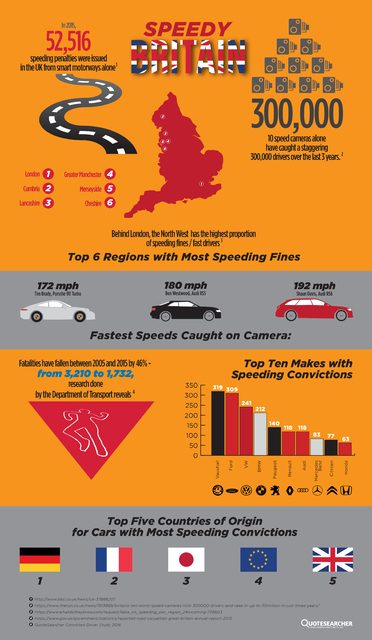
Every year, as cars get faster and technology progresses, so it seems the law comes down harder and harder on drivers who misbehave behind the wheel. Punishment for mobile phone use recently doubled, but for most drivers their speeding is what can put them on the wrong side of the law.
Most of us have been caught out at some stage by a speed camera or a craftily placed police car, ready to pounce the second they see a car exceeding the speed limit. Or when you are driving in an unfamiliar area and didn’t notice the limit shift from 40mph to 30mph, until those two telltale flashes fill your review mirror.
In the UK, many people see speed cameras simply as another form of revenue, like a hidden road tax. However, even these skeptics cannot deny that the main aim of speed cameras is to make the roads a safer place for both pedestrians and drivers alike. The falling rate of road deaths in the UK is testament to the fact that, money spinner or not, speed restrictions have made our roads a safer place.
Combined with their own research, QuoteSearcher have put together this infographic showing the speeding habits of UK drivers, and just how much revenue some speed cameras actually yield…

How to Travel with Babies
